PMX · Product workflow · Working prototype
Make the next
decision clear.
What should happen next—and what do we need to know before it starts?
PMX turns product intent into a bounded piece of work: research, a feasibility check, a design or an implementation plan. People agree the scope, review what comes back and use the result to decide the next step.
Explore the decision loopInside the current local prototype · 21 October 2026
See the next decision in context.
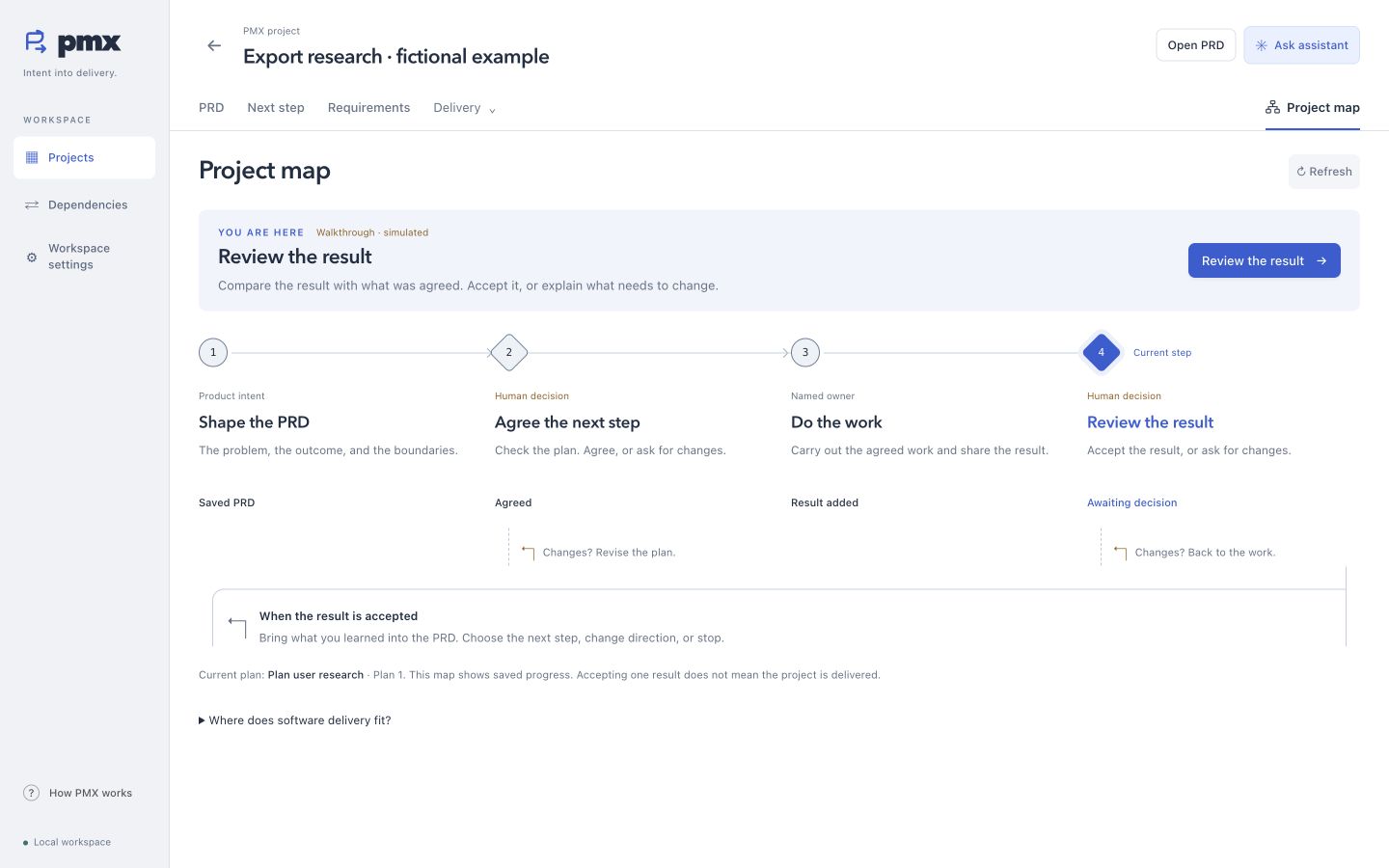
The project map connects the saved PRD, the agreed activity and its result. Here, a fictional research plan has been returned and is waiting for review.
Explore the activity rules · Three examples
Ready for what?
The same PRD can be ready for one activity and incomplete for another. Select a step to compare what it needs.
Define how to answer the question.
Before starting
A specific uncertainty, the decision it affects, the research boundaries and what a useful plan should contain.
During this activity
Choose the method, participant criteria and access approach.
What should come back
A reviewable research plan. Findings and recruited participants are not prerequisites for planning.
Illustration of the implemented activity rules. A person reviews the actual plan and decides whether the work can begin.
Readiness follows the activity
Enough to start.
Room to learn.
The current interface separates what must be settled before starting from what the activity should resolve during the work.
A research plan needs a clear uncertainty and a decision it will inform. Choosing the method can be part of the planning; completed findings belong to a later activity.
Captured from the same fictional walkthrough, before agreement. The checks support a human review.
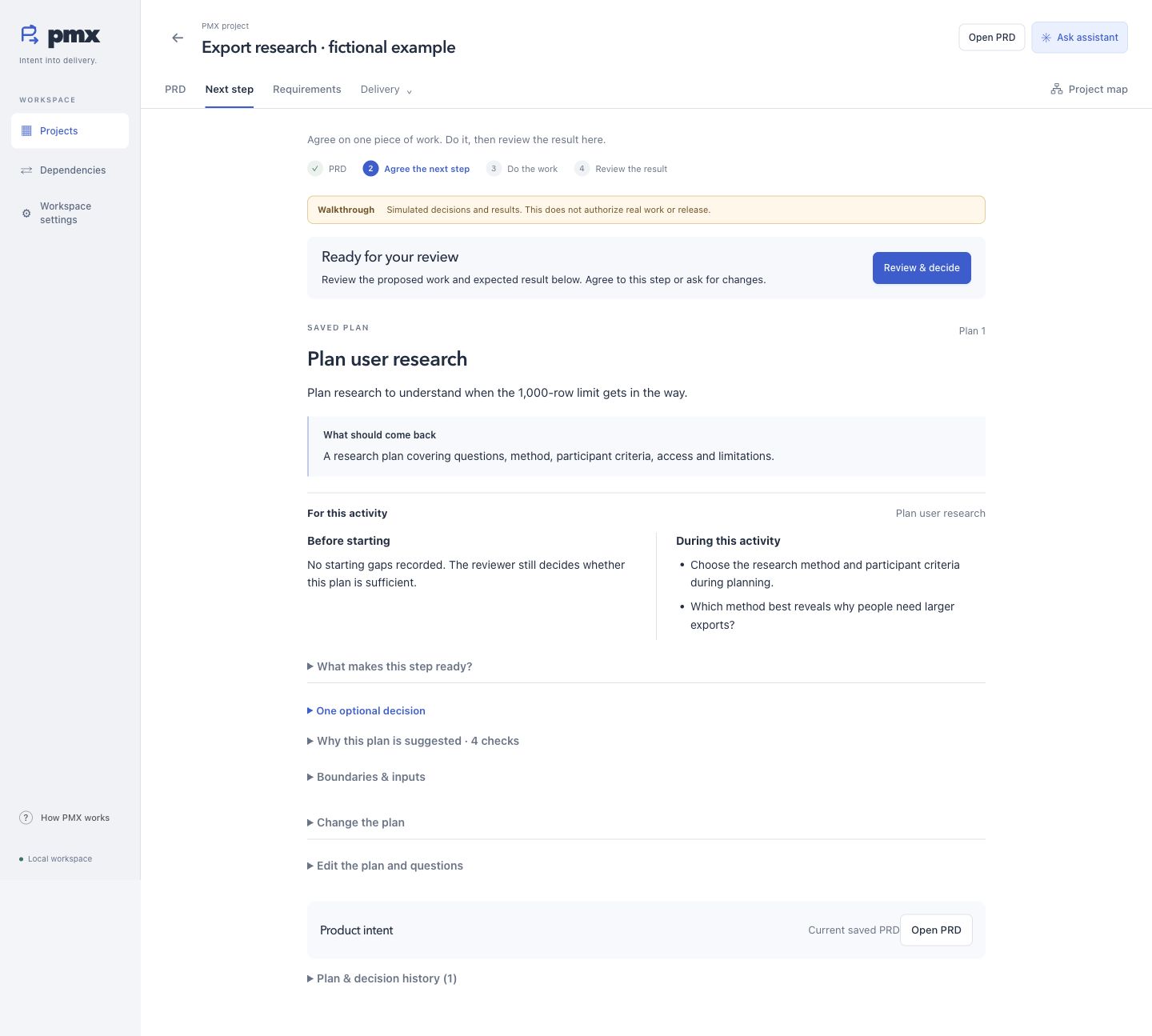
Captured from the running app · 21 October 2026
Follow it in the interface.
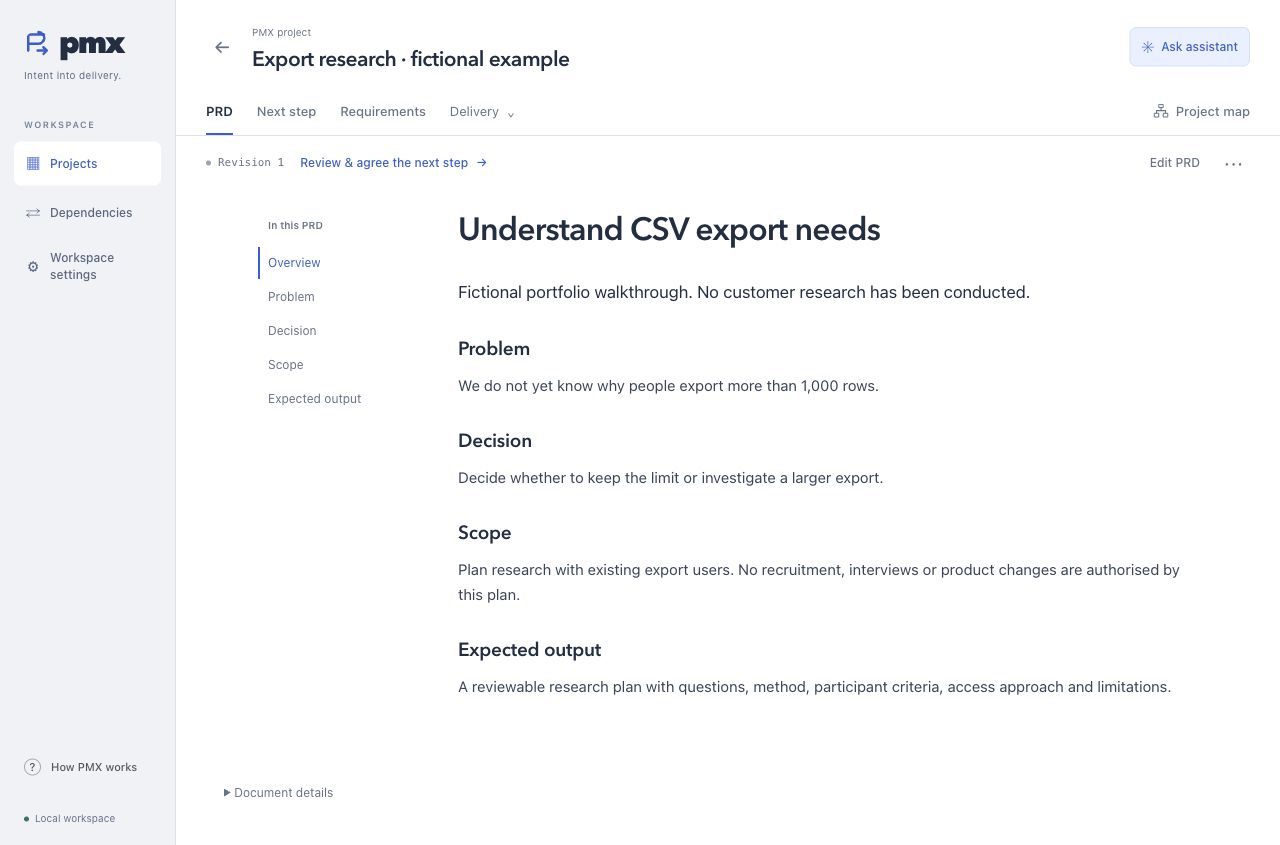
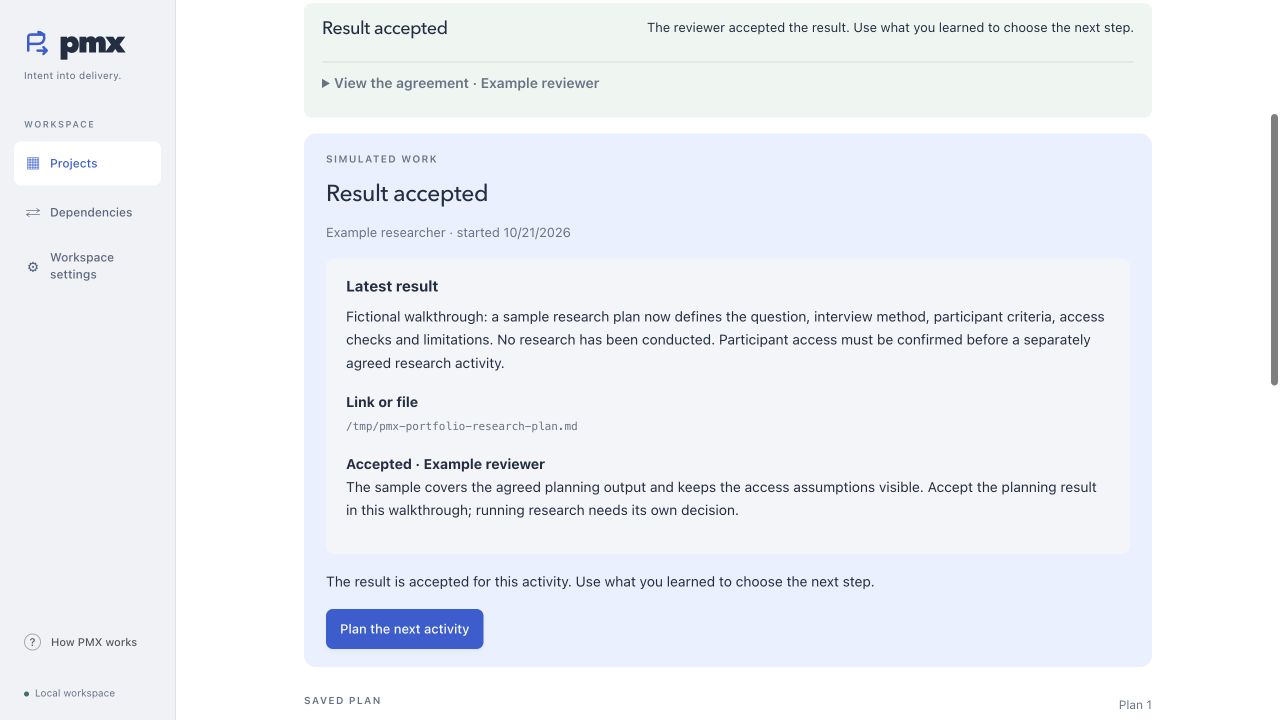
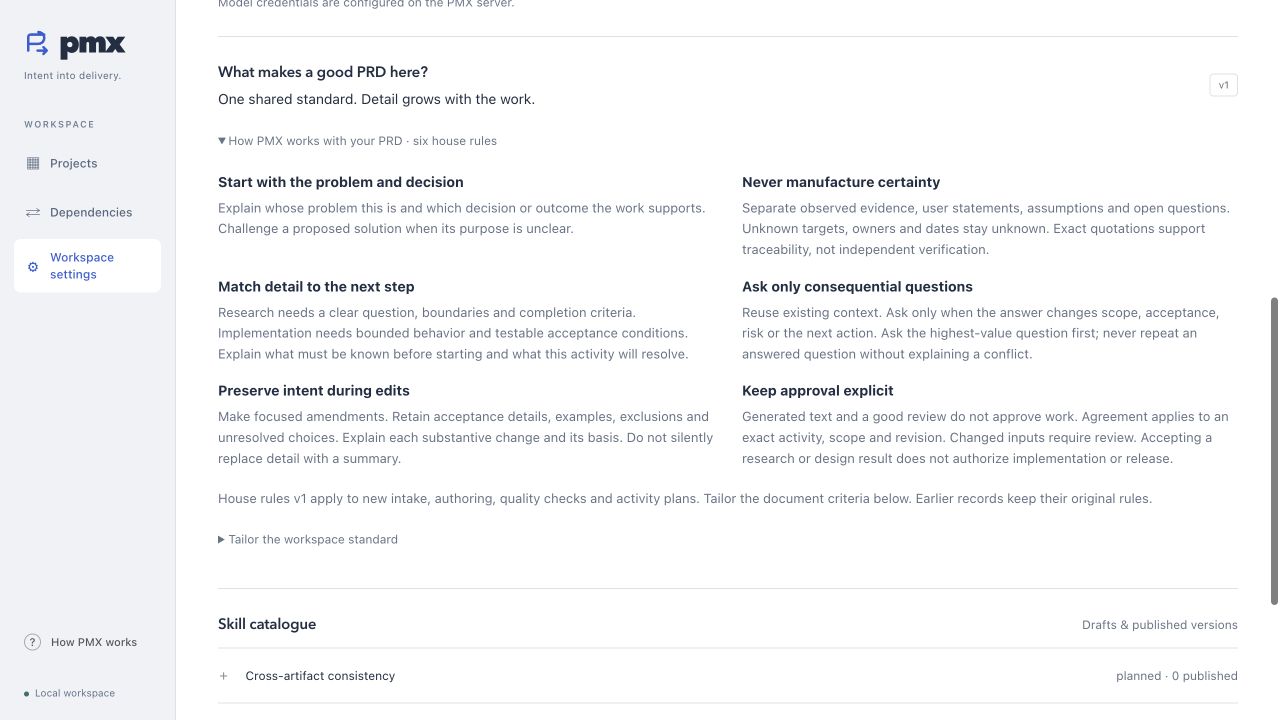
A local walkthrough followed this fictional project from its saved PRD through agreement, a recorded start and result acceptance. Open a capture to inspect the full interface.
The core workflow
One useful step.
Then another decision.
- 01
Shape the PRD
Start with an idea or capture existing context from Linear. Develop the problem, outcome and boundaries in a working draft; review proposed changes before applying them.
- 02
Agree the next step
Choose an activity, define what should come back and review its starting conditions. A person agrees to that scope or asks for changes.
- 03
Do the work
Record a named owner and the start of the agreed activity. The work happens outside PMX; bring back a result reference and a summary, including limitations.
- 04
Review the result
Compare the result with the agreement. Accept it or ask for changes, then bring the learning into the PRD and choose what comes next.
After review, update the PRD, choose another activity, change direction or stop.
Five supported activities
- Plan user research
- Run user research
- Check technical feasibility
- Design the solution
- Plan implementation
Decisions behind the design
Consistent rules.
Specific questions.
A shared basis for assistance
Intake, draft authoring, evaluation and activity planning share six house rules: start with the problem, keep uncertainty visible, match detail to the next step, ask consequential questions, preserve intent and keep approval explicit. Workspace settings put those rules beside the editable PRD standard and review criteria.
Review the work in front of you
Evaluate a saved draft or captured source, either as a document or for a selected activity. Reviews retain the document and criteria they used. Exact source quotations make the assessment traceable.
Let changed context reopen the decision
Agreement belongs to a particular plan and its inputs. A changed PRD, new discussion or unreconciled answer calls for review. Switching from research planning to solution design requires fresh readiness checks.
When the next step involves software
Carry the agreement
into delivery.
Dedicated workspaces support requirement review, technical design and a versioned handover. The receiver can accept the issued package or ask for clarification. Delivery records distinguish implementation, verification, release and outcomes.
This delivery path sits alongside the activity loop. Agreement to plan research covers only that activity. Running research, implementation and release need their own decisions.
AI prepares proposals. People apply edits, agree work and review results. A reference to a file or report is recorded evidence; PMX does not inspect that file or independently verify its claims.
Current state · Local working tree reviewed 21 October 2026
Working locally.
Still a prototype.
The current local build includes the activity loop, project map, shared house rules, activity-specific readiness, saved-draft evaluation and revised settings. This checkpoint includes the latest workflow and settings changes.
The local application keeps its records in SQLite and runs as a single-operator workspace. All 252 automated tests and the production build passed at this checkpoint. The screenshots above use isolated fictional data; they demonstrate the interface, not customer adoption or measured productivity.
A September feedback-pilot walkthrough covered the software-delivery path. The hosted pilot was last confirmed inactive on 20 October; the latest local changes are not presented as a hosted release. Reviewer names remain self-reported, with organisational identity, multi-user access controls and autonomous execution still outside the delivered scope.
The longer-term direction is progressive delegation to an organisation’s chosen agents, with authority attached to each agreed piece of work.
Discuss PMX